
8 July 2026

8 September 2026
To help shed light on how cases move through the criminal justice system in Aotearoa, the Ministry of Justice published a study tracking 23,739 reported sexual violence victimisations over a four-year period.
Of the sexual violence victimisations reported to Police:
Because research estimates that only around 10% of sexual violence is ever reported to Police,² this means that out of every 100 actual victimisations, approximately three result in charges, and only one leads to a conviction.
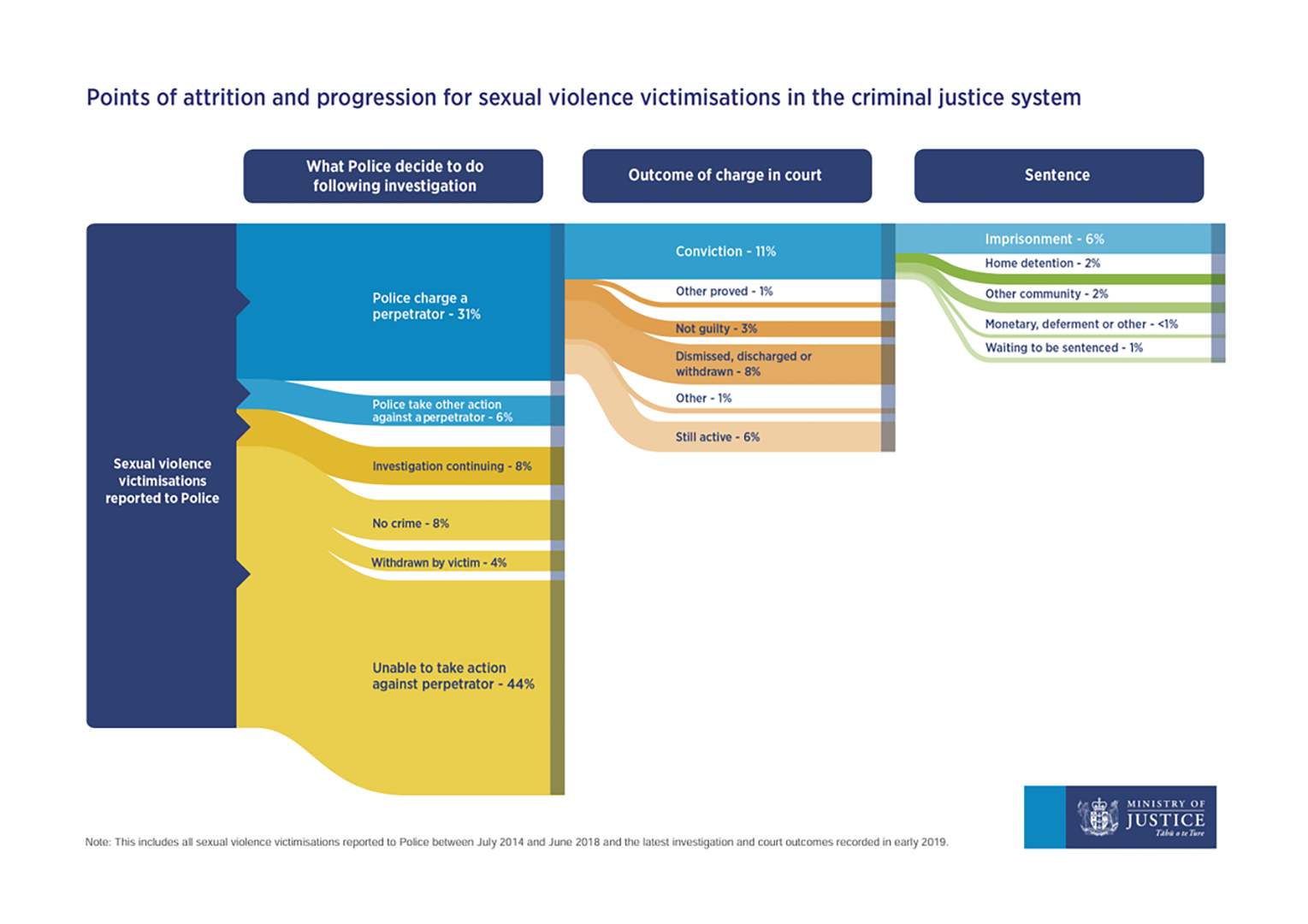
The study found that the largest drop-off in cases happens during the initial investigation stage, with 56% of reported cases unable to proceed to court.
There are many reasons an investigation might not move forward, including:
A case not progressing through the justice system never means the sexual harm did not happen. The legal system relies on strict thresholds of evidence, which do not reflect the reality or validity of your lived experience.
For the 31% of cases where charges were laid, outcomes varied as they moved through the court process:
After a perpetrator is convicted, they receive a sentence from the court.
Of the cases included in this study:
Whether you are considering reporting to the Police, currently navigating court processing, or choosing not to engage with the legal system at all – your choice is valid!
We will walk alongside you wherever you are in your journey, in whatever capacity you need. We offer non-judgemental guidance, court advocacy, practical support, or simply a safe, quiet space to visit.
If you or someone you care about needs support, we are always here for you.
The study included sexual violence victimisations reported between July 2014 and June 2018, with the latest investigation and court outcomes recorded in early 2019.
Because sexual violence cases can take considerable time to progress through the justice system, some cases were still active when the analysis was completed.
More information about this analysis is available in the full report: Attrition and progression: Reported sexual violence victimisations in the criminal justice system.
¹ Ministry of Justice (2019). Points of attrition and progression for sexual violence victimisations in the criminal justice system. Wellington: Ministry of Justice.
² Ministry of Justice (2015). 2014 New Zealand Crime and Safety Survey: Main findings, Wellington: Ministry of Justice.
³ Note that the proportion where the victim withdrew is underrepresented, as the specific ‘withdrawn by victim’ outcome category was only introduced and used from early 2017 onwards, and these outcomes would otherwise have been recorded in ‘unable to take action’.
8 July 2026
1 May 2026

5 February 2026